



He created his own unique style. He was inspired by the place where he lived and worked: the countryside.
Toth Menyhert was a unique painter who held a special place in Hungarian art. He studied at the Hungarian Academy of Fine Arts from 1930 to 1935 in the studio of Janis Vaszary. During his studies, he was fascinated by Cubism, but even then he was already incorporating folkloric motifs from his homeland, where he returned after completing his studies. He had his first exhibition in 1941, and then for almost thirty years he stopped presenting his work publicly, even though he was officially a member of the Baja group and the Tokaj group of artists. He made a living from working on the land and painting rooms.
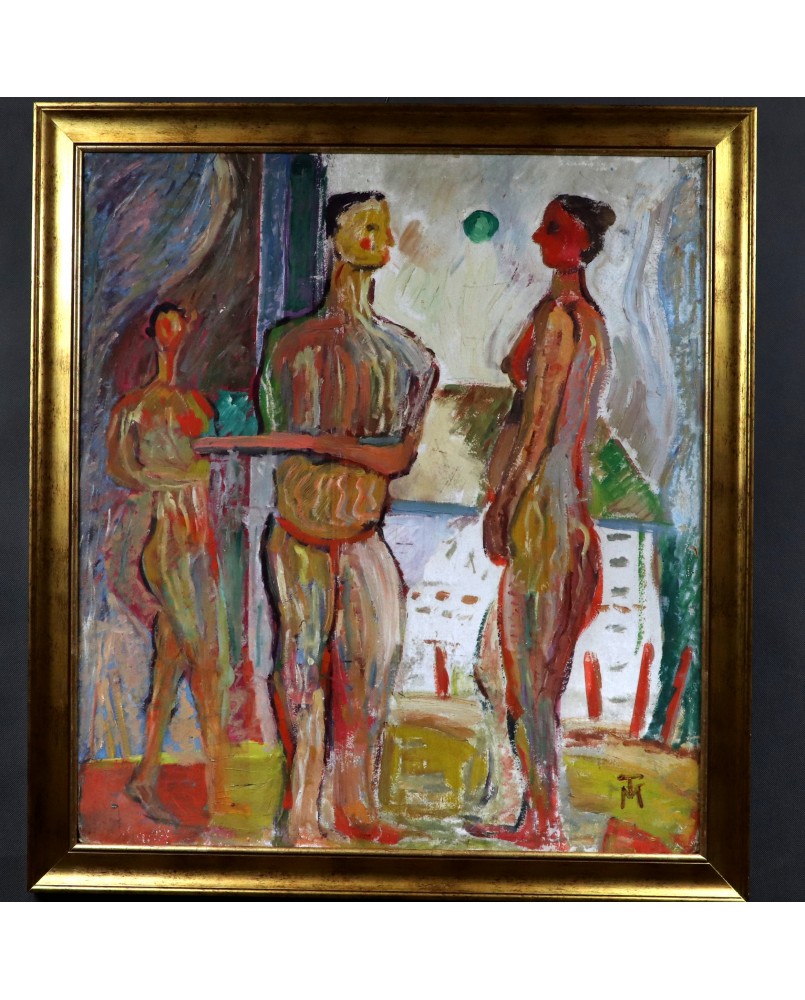
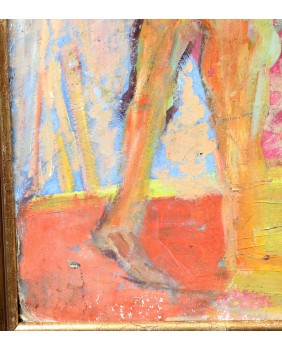
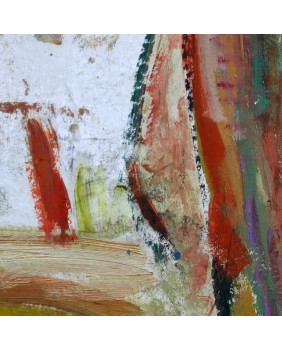
This does not mean that he stopped painting. He created his own unique style. He was inspired by the place where he lived and worked: the countryside, with its beliefs, superstitions, and primitive understanding of good and evil. He was able to clothe this in the garb of modern art. He used all its tools without straying from representational, figurative painting. He wove archaic motifs and Hungarian rural folklore into his work. His painting also contained a huge emotional charge. Over time, he simplified his forms, approaching the ideal of a sphere. In 1974, he began his "white period" in painting. White lines became increasingly expressive. Colors began to lean toward white, which he considered the most complementary color in art. Toth Menyhert created his art in solitude, but he was in no way out of step with global art trends.
Discovered by collectors after an exhibition in 1968, his paintings found their way into the largest Hungarian museums and galleries. Posthumously, in 1990, he received the Kossuth Prize, one of the most important awards for Hungarians. The prices of his paintings reach tens of thousands of euros.
I bought the painting by accident. I was not familiar with Menyhert's work. I did not know what I was buying. I liked it and did everything I could to get it. As it turned out, it was a bargain. The price I am asking is also a bargain, at the lower end of the estimated value of his works. Of course, I am willing to submit the painting to any verification requested by the buyer.
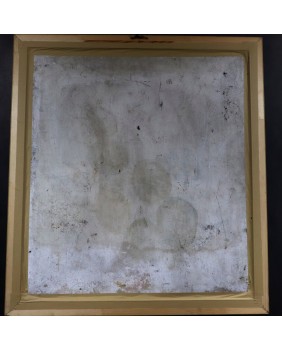
The painting is large. It is painted on cardboard with gouache or oil paints. With this method of painting, I cannot tell which it is. The cardboard itself measures 79 by 70 cm. With the frame, it measures 88 by 80 cm.
He created his own unique style. He was inspired by the place where he lived and worked: the countryside.