


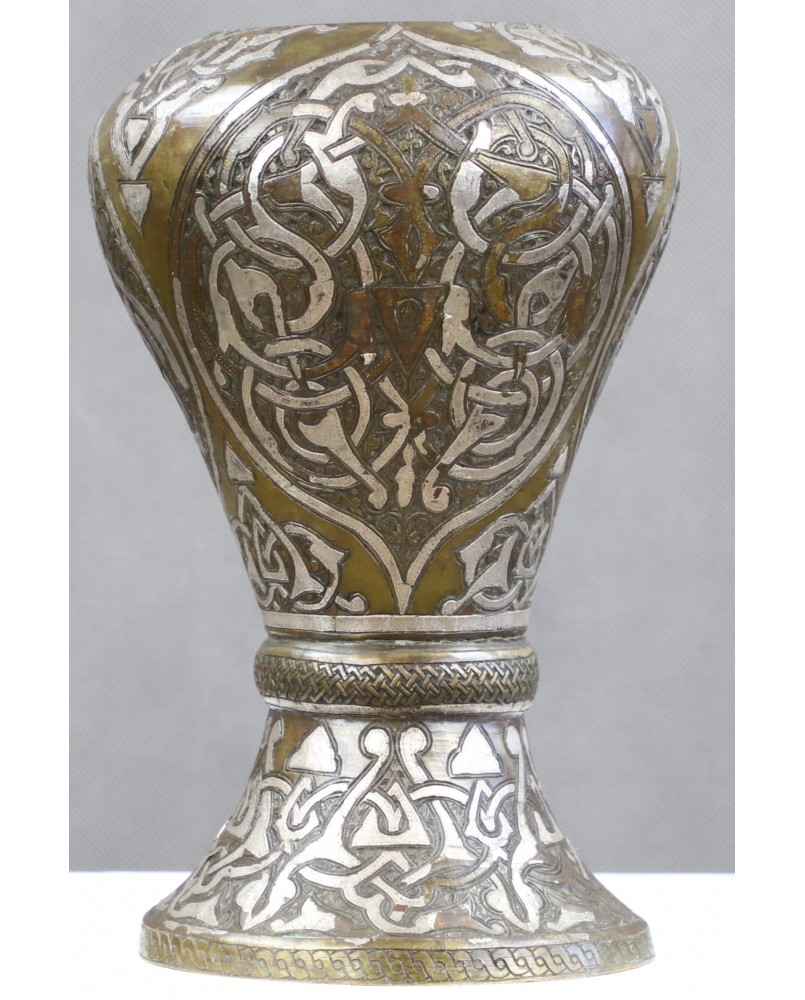
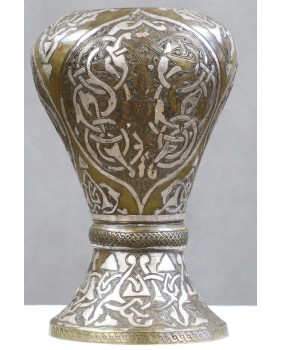
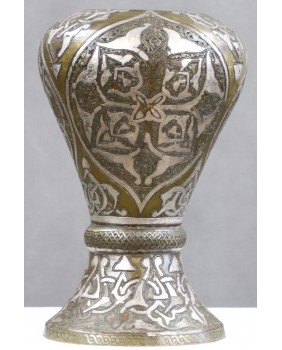
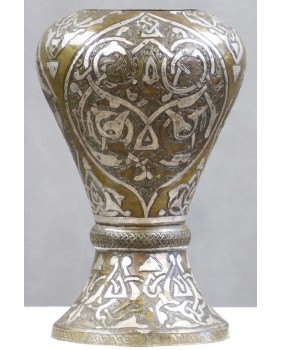
I believe that the vase was made in Egypt at a time when its modern statehood was emerging. Awareness of its own national identity meant that art during this period referred to one of the greatest periods of Islamic artistic creativity, the "Mamluk Renaissance."
I bought the vase at a time when I was convinced that I liked Islamic art. Today, I am no longer so sure, but a few items remain in my collection. Perhaps it would be an exaggeration to say that I dislike it. I don't know it would be more accurate. I get lost in the thicket of Arabic decorations, I don't know calligraphy, which is often an important element of this art. I am having great difficulty determining the region from which the item comes and when it was made.
The description of the vase is the result of online research. If I have made a mistake in its identification, I will gladly correct it. One thing I am sure of is that it is not a contemporary product. My thirty years of experience are enough to tell me that.
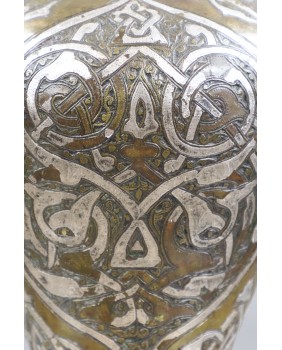
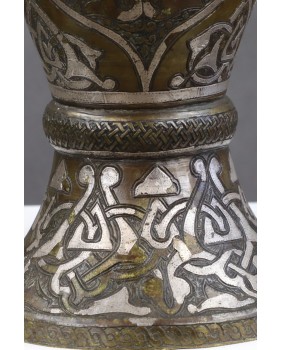
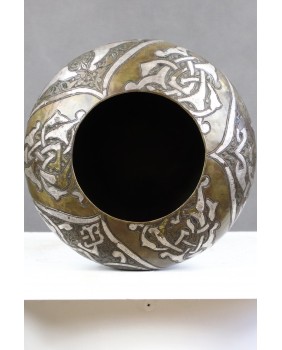
I believe that the vase was made in Egypt at the time when its modern statehood was emerging. Awareness of its own national identity meant that art in this period referred to one of the greatest periods of Islamic artistic creativity, the "Mamluk Renaissance." To be more precise, it was created at the turn of the 19th and 20th centuries or at the beginning of the 20th century. It is an example of the use of geometry in the creation of complex decorations covering the entire surface of the vessel, referring to the idea of the infinity of God's essence. Additionally, it represents the Arabic art of inlay, which uses two different metals in its decorations. The shape of the vase is quite unusual, but such shapes did exist.
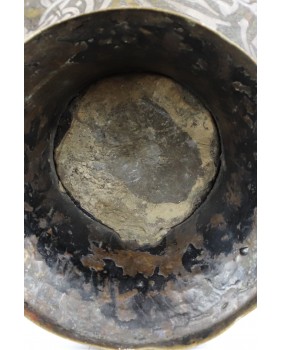
Unfortunately, it is not in museum condition. It has a distinct indentation on the lower rim, the bottom is filled with some heavy substance, and a large part of the white metal decoration has fallen off.
The vessel is 26 cm high. The diameter of the belly is 17 cm and the base is 14 cm.
I believe that the vase was made in Egypt at a time when its modern statehood was emerging. Awareness of its own national identity meant that art during this period referred to one of the greatest periods of Islamic artistic creativity, the "Mamluk Renaissance."