


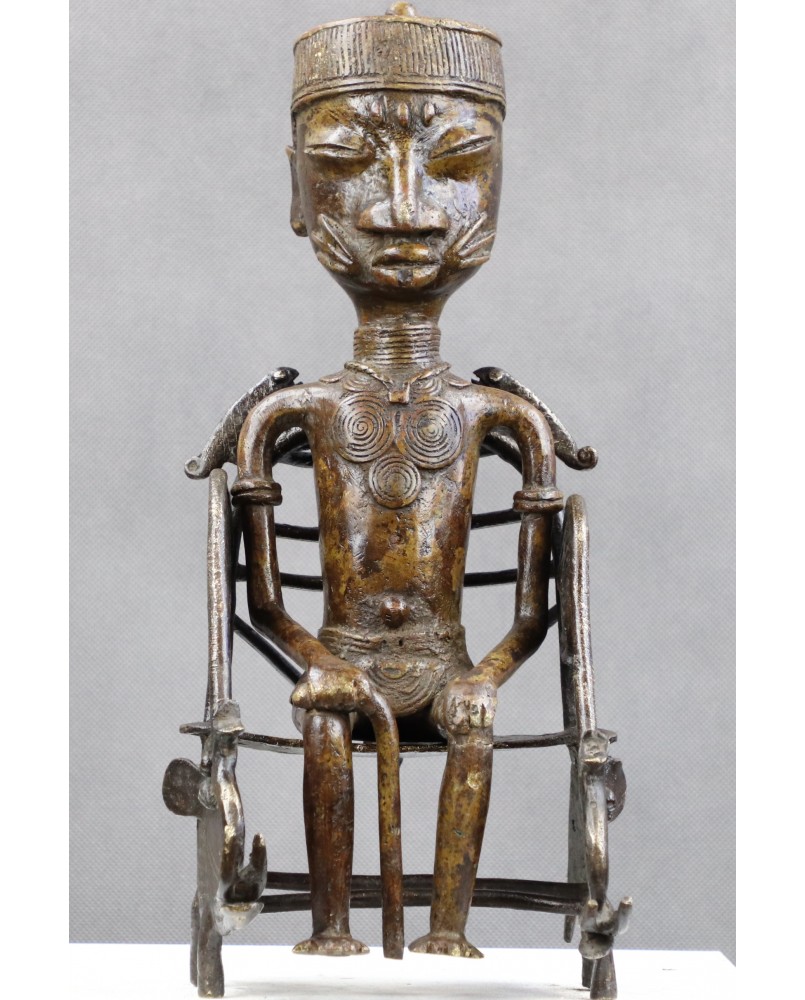
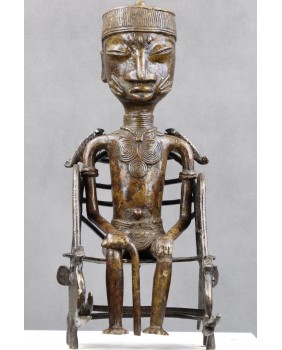
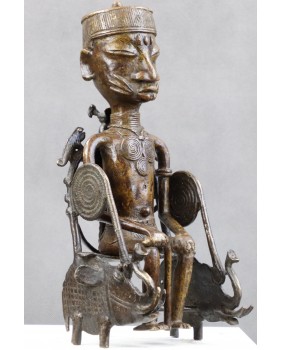
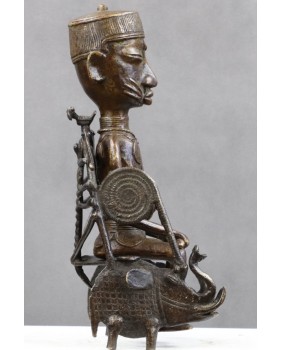
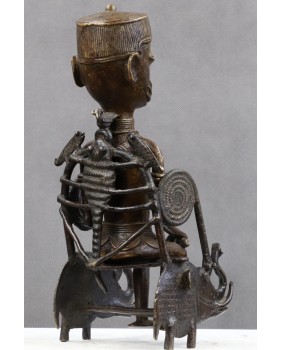
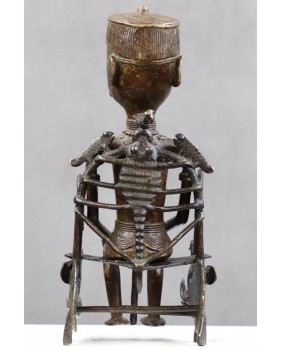
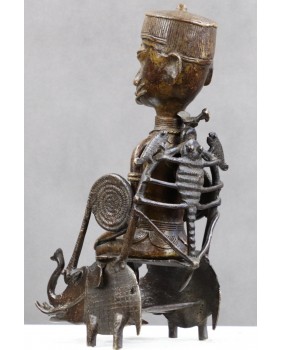
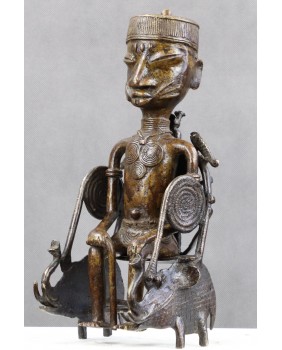
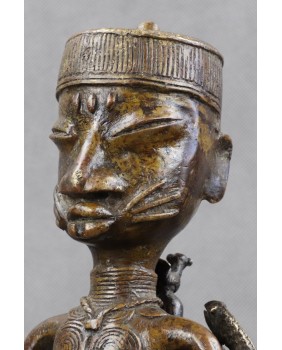
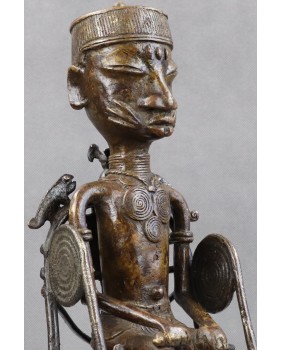
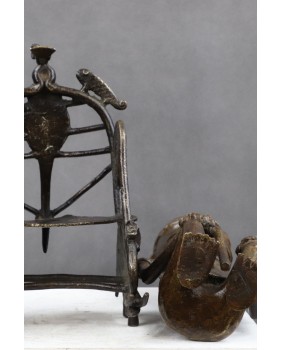
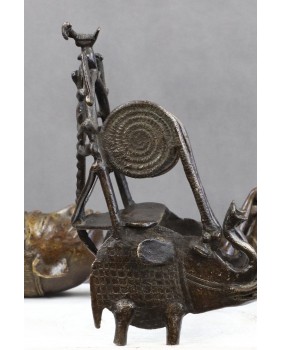
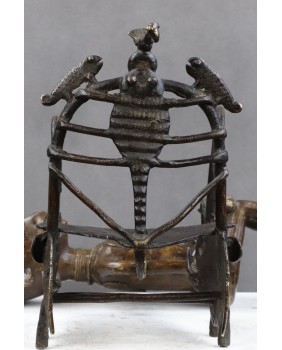
The sculpture depicts a dignitary of the royal family in all his majesty. He sits on a throne whose base is formed by elephants, the most powerful animals in Africa, and whose armrests are coiled snakes. On the backrest, we see a scorpion, two chameleons, and a bird. These animals symbolize strength, wisdom, and cunning.
At the end of the 17th century, the Akan peoples were united by the chiefs of the Ashanti tribes and merged into a powerful empire. Rich in gold, trading in slaves and colonial goods needed by white people, they dominated this part of Africa. Their extraordinary militancy allowed the Ashanti Kingdom to maintain its independence from colonial influence for a very long time.
In Ashanti art, gold products were most highly valued. Other metals were also highly respected, and their craftsmen mastered the art of lost-wax casting and created beautiful objects. As in every African kingdom, objects determined the status of their owner, marking their position and prestige. The most impressive and beautiful ones belonged, of course, to the king and were part of the royal regalia.
Interestingly, there are few masks in this culture. They were not common in rituals, which were dominated by figurative sculptures, especially female figures, as an important element of the rituals was the cult of fertility and motherhood. Inheritance was through the female line, so the position of women is understandable.
An interesting phenomenon in Akan art are the weights used to weigh gold dust. They were made of brass and depicted objects, people, animals, and abstract ideas.
The sculpture on offer depicts a dignitary of the royal family in all his majesty. He sits on a throne, the base of which is formed by elephants, the most powerful animals in Africa, and the armrests are coiled snakes. On the backrest, we see a scorpion, two chameleons, and a bird. These animals symbolize strength, wisdom, cunning, and deadly power. The man is depicted very statically, which emphasizes the seriousness and even haughtiness of the character. His dignity is further emphasized by metal decorations characteristic of the Akan tribes. The scarifications on the king's face are arranged in such a way that they may suggest a leopard mask. The dignitary leans on a cane, which in Africa is a symbol of power, and in Ashanti art, decorative canes form a separate category. Similarly to stools, decorative seats should be owned by every male member of the Akan tribe. The throne is reserved for the royal family. The exception is the woman sitting on the throne, breastfeeding. This symbol of motherhood is one of the most beautiful representations of African tribal art.
The sculpture is 38 cm high and 16 cm wide. Its depth is 15 cm. It is slightly unstable, but it is enough to lightly file down the legs of the throne. Second half of the 20th century.
The sculpture depicts a dignitary of the royal family in all his majesty. He sits on a throne whose base is formed by elephants, the most powerful animals in Africa, and whose armrests are coiled snakes. On the backrest, we see a scorpion, two chameleons, and a bird. These animals symbolize strength, wisdom, and cunning.