


Although he claimed that he was never a theorist and was not suited to professorship, his works seem to contradict this. His works always begin with a question about the properties of the material from which a new entity, an individual work of art, is created.
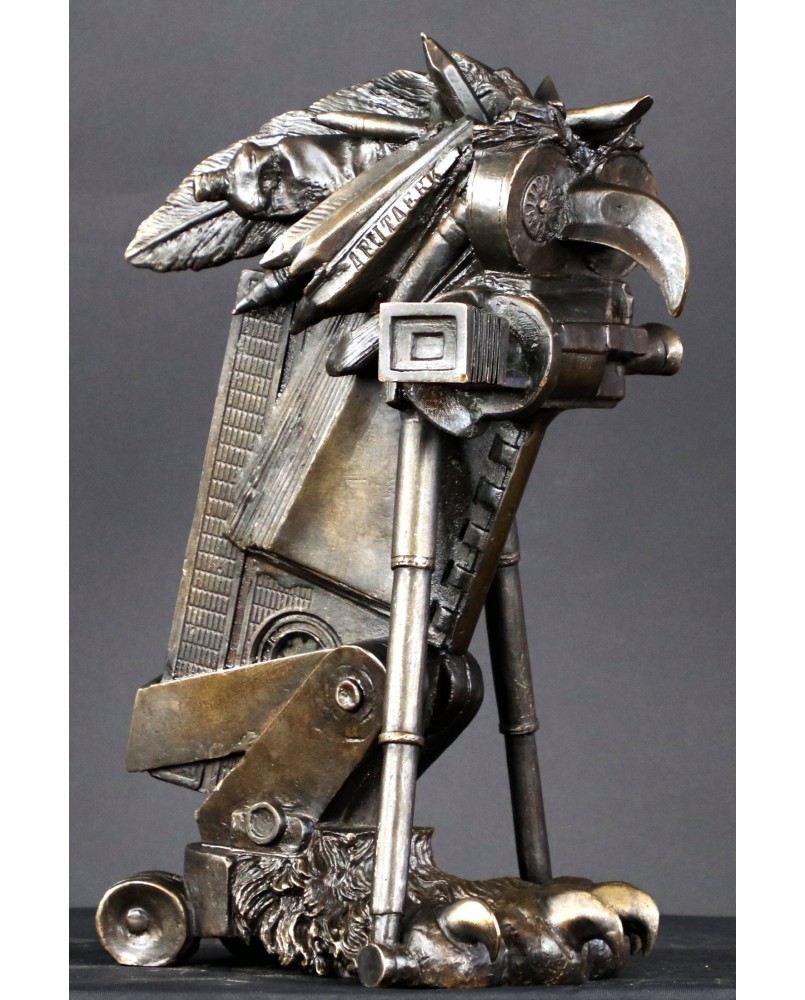
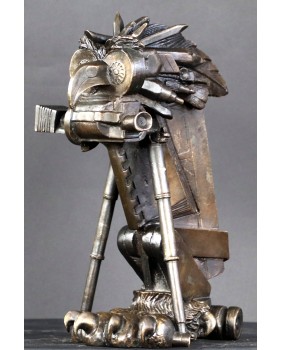
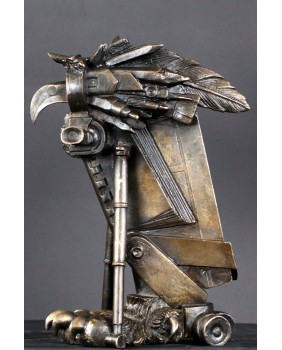
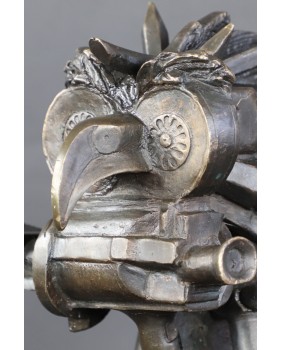
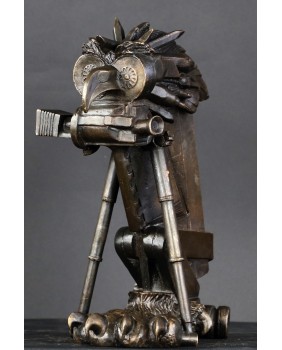
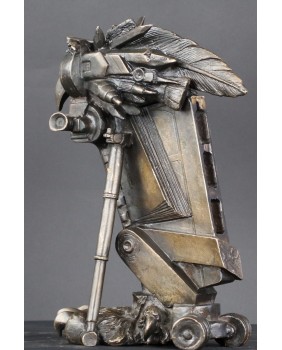
This sculpture got into my head and refused to leave. I went to great lengths to make it mine. I did so without knowing its origin or author. Perhaps the source of this fascination lay in memories from my youth. The sculpture reminded me very much of Super Bird Dudi from the satirical weekly magazine Szpilki.
Today, I know that the sculpture is a prize in the Kreatura competition. The competition has been organized since 1996 by Media i Marketing Polska. Its aim is to recognize the creators of Polish advertising art.
The award statuette was designed by Krystian Jarnuszkiewicz. An extremely interesting artist, he has been involved in sculpture throughout his creative life. Admittedly, his older brother Jerzy has made a greater impact on the public consciousness, mainly due to the fact that he was the author of the sculpture Mały Powstaniec (Little Insurgent), depicting a little boy in an oversized helmet with a huge rifle.
Krystian was born in 1930 in Mysłowice, Silesia. He survived the war in Warsaw. His childhood experiences during the Warsaw Uprising left him traumatized for the rest of his life.
Krystian claimed that his father had the greatest influence on his work. A craftsman who ran a metal workshop, he was able to make extraordinary things out of sheet metal. It was sheet metal that became the reference point for all the materials the artist later worked with.
Krystian Jarnuszkiewicz graduated from the State Higher School of Fine Arts in Wrocław in 1956, where he studied in Bogdan Michałowski's studio, and then moved to the Academy of Fine Arts in Warsaw. He continued his education in his brother Jerzy's studio and in Professor Oskar Hansen's Solid and Surface Design studio.
From 1977, with a break between 1980 and 1985, he worked as a teacher at the Academy of Fine Arts in Warsaw. He taught in Professor Marek Sarełło's sculpture studio and later at the Faculty of Design in Wiktor Gutt's studio.
He was interested in several issues in the field of sculpture. The transformation of space, the plasticity of materials (his stay in Canada and the experience he gained there in the field of materials science and engineering had an influence on his research), and the expression of found materials.
Although he claimed that he was never a theorist and was not suited to a professorship, his works seem to contradict this. His work always begins with a question about the properties of the material from which a new entity, an individual work of art, is created. He was interested in monumental sculpture. He took part in numerous competitions for monuments and memorial sites. He received several distinctions and awards in these competitions, and together with his wife, he won the competition for the monument to the Poznań June 1956 uprising. However, the innovative nature of this project caused numerous protests from the residents of Poznań, and the project was not implemented.
His designs were always comprehensive, making use of the space of the commemorated site and unconventional sculptural materials.
He received an award at the Metal Sculpture Biennale in 1968. It was a large project in which Warsaw industrial plants made their facilities and scrap metal available to artists. Thirty-five artists took part in it, creating 60 objects decorating the urban space of Warsaw as part of the Car Gallery. Jarnuszkiewicz's "Totem" adorns Aleja Jana Pawła II.
He was an extraordinary artist. His sculptures found their way to the National Museum in Warsaw, the Art Museum in Łódź, Katowice, and the Sculpture Center in Orońsko, where he participated in several open-air events and sculpture festivals. He worked for Polish Television for some time. He played a major role in Krzysztof Zanussi's film "The Structure of Crystal." I do not have enough space here to list all the individual and collective exhibitions in Poland and abroad in which he participated.
He was probably not interested in the commercial sale of his works, or at least I have not found any auction listings for them.
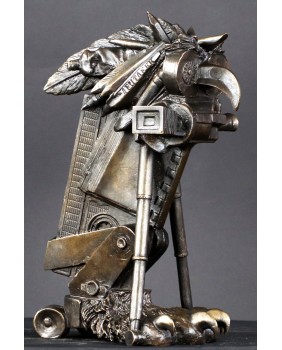
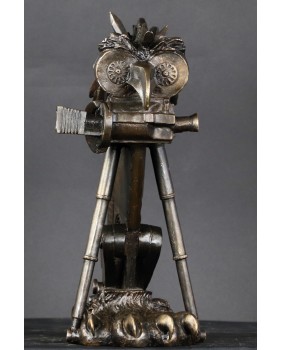
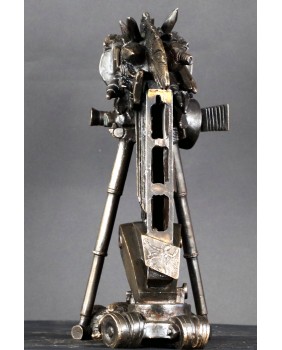
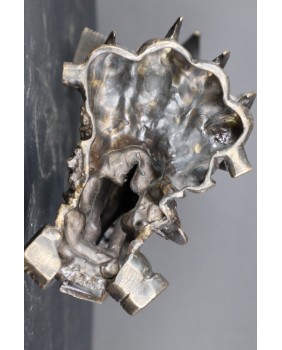
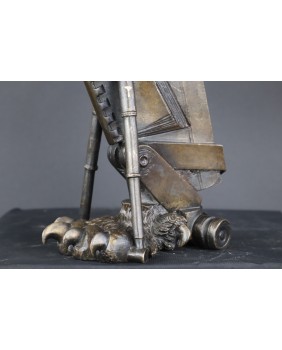
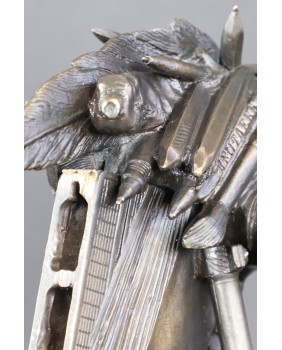
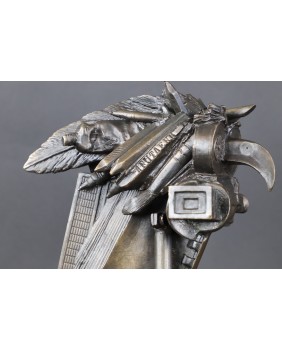
The "Kreatura" project is characteristic of Jarnuszkiewicz, although it was probably filtered through the commercial expectations of the organizers. It was created from objects used on a daily basis by people
creating new artistic and intellectual values. Pencils, crayons, brushes, tubes of paint, a notebook, video cassettes, a film camera. There was even a quill pen. The bird on the lion's paw most resembles a camera from a film studio. It documents in practice a new expression of found objects, one of the areas of sculpture that the artist was involved in.
The sculpture is 30 cm high, 14 cm wide, and about 20 cm deep.
Although he claimed that he was never a theorist and was not suited to professorship, his works seem to contradict this. His works always begin with a question about the properties of the material from which a new entity, an individual work of art, is created.