


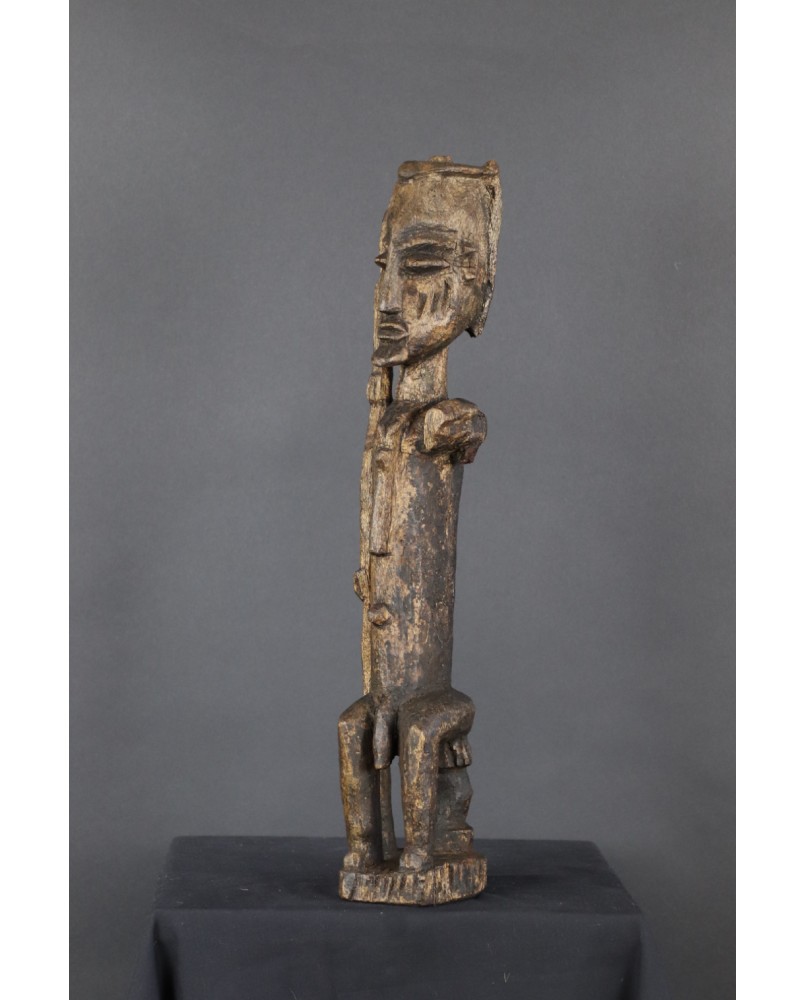
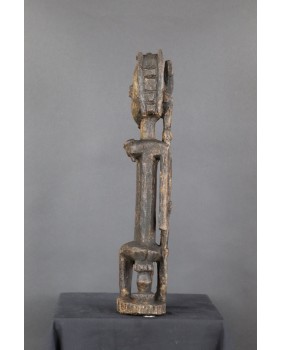
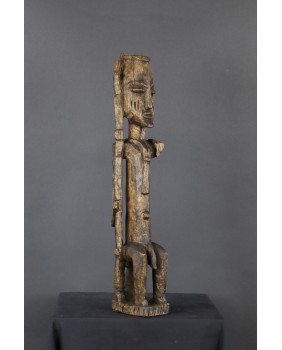
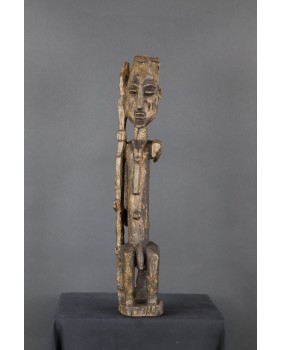
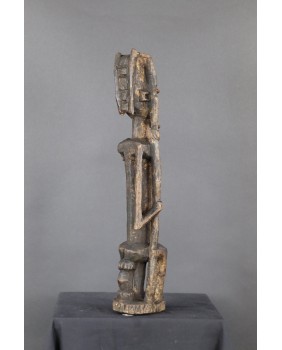
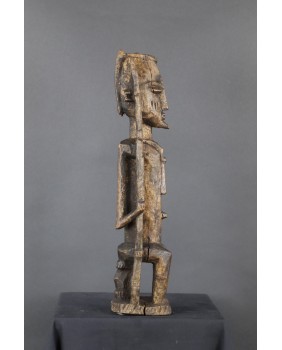
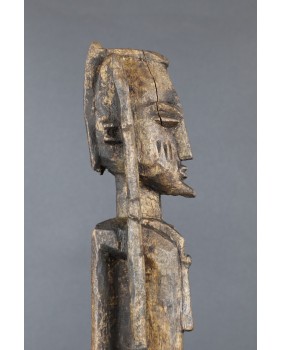
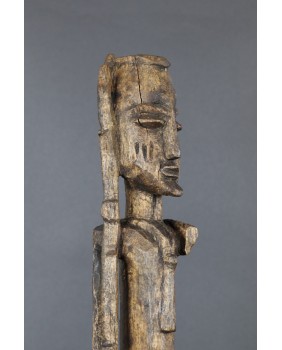
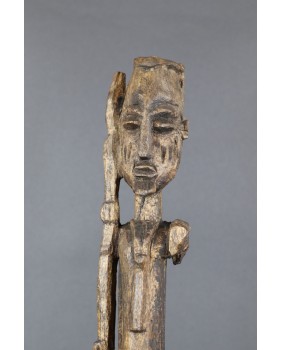
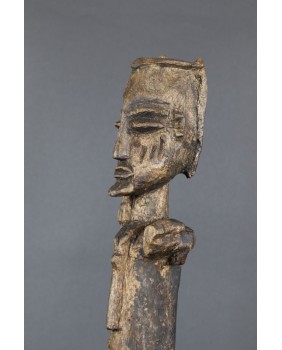
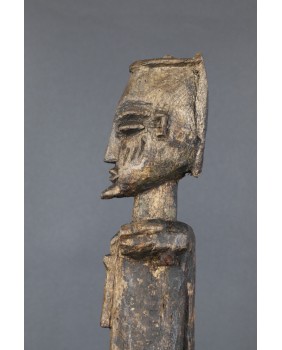
Dogon sculptures, and the sculpture I am offering is a beautiful example of this, depict the human body in a simplified way. They are elongated with an emphasis on geometric forms. The figures are almost cubist. They have oval heads, square shoulders, and straight, long limbs that taper downwards. However, the stylization and simplification do not deprive the sculptures of their individual character.
Any attempt to write a brief description of the Dogon people and their art would probably end in disaster. They are one of the most mysterious peoples in Africa, and yet volumes have been written about them. To this day, the Dogon cosmogony and their belief that the ancestors of the tribe were created by gods, sent to earth in an Ark moving through the skies, and that they were bisexual aquatic beings, continue to fascinate. The Dogon knew that the Earth revolves around the Sun, they knew about Jupiter's moons and Saturn's rings.
The Dogon people lived in relative isolation for many years. Retreating from the advancing Mossi, they reached the south of Timbuktu and built their villages on the cliffs of Bandagara. They created a strictly hierarchical, orderly society. They are divided into clans grouping members of the same family. The clan is ruled by a patriarch who is also the guardian of the family sanctuary. The Dogon community is also organized into associations responsible for guiding a member of the tribe through the most important stages of his life. Circumcision, initiations, marriage, funeral. The myths on which education is based determine man's place in nature, society, and the universe. The totemic cult of animals and the division into castes create a complex network of interdependence among tribe members.
Sculptors form one of the castes. This skill is passed down hereditarily, and marriages can only be contracted within the caste. Dogon art is subordinate to myths that organize life at every level. At the same time, art contains secrets, access to which is regulated by successive degrees of initiation of its members. Suffice it to say that there are over 80 types of masks among the Dogon. In addition, there are figures of men, women, hermaphrodites, warriors, horsemen, priests, pregnant women, motherhood, stools, pillars, granary doors, and door locks. Everything is created according to a strictly defined canon and stored in countless places of worship. Personal and family altars are intended to ensure successful hunting, rain, good harvests, and numerous offspring.
Dogon sculptures, and the sculpture I am offering is a beautiful example of this, depict the human body in a simplified way. They are elongated with an emphasis on the geometrization of form. The figures are almost cubist. They have oval heads, square shoulders, and straight, long limbs tapering downwards. However, the stylization and simplification do not deprive the sculpture of its individual character. As in the case of this sculpture, we can see facial hair, scarification, an amulet around the neck, bracelets, and we can recognize the type of weapon with which the Dogon warrior is equipped. Dogon sculptures are characterized by the solemnity, immobility, and dignity of the figures depicted.
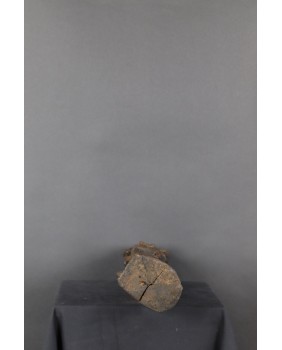
The sculpture was created in the second half of the 20th century. For relatively little money, you can become the owner of a sculpture that meets all the canons of Dogon art. The missing arm is obviously a flaw, but also a testament to the passage of time.
The sculpture is small. It is 46 cm high, 8 cm wide, and 11 cm deep.
Dogon sculptures, and the sculpture I am offering is a beautiful example of this, depict the human body in a simplified way. They are elongated with an emphasis on geometric forms. The figures are almost cubist. They have oval heads, square shoulders, and straight, long limbs that taper downwards. However, the stylization and simplification do not deprive the sculptures of their individual character.