


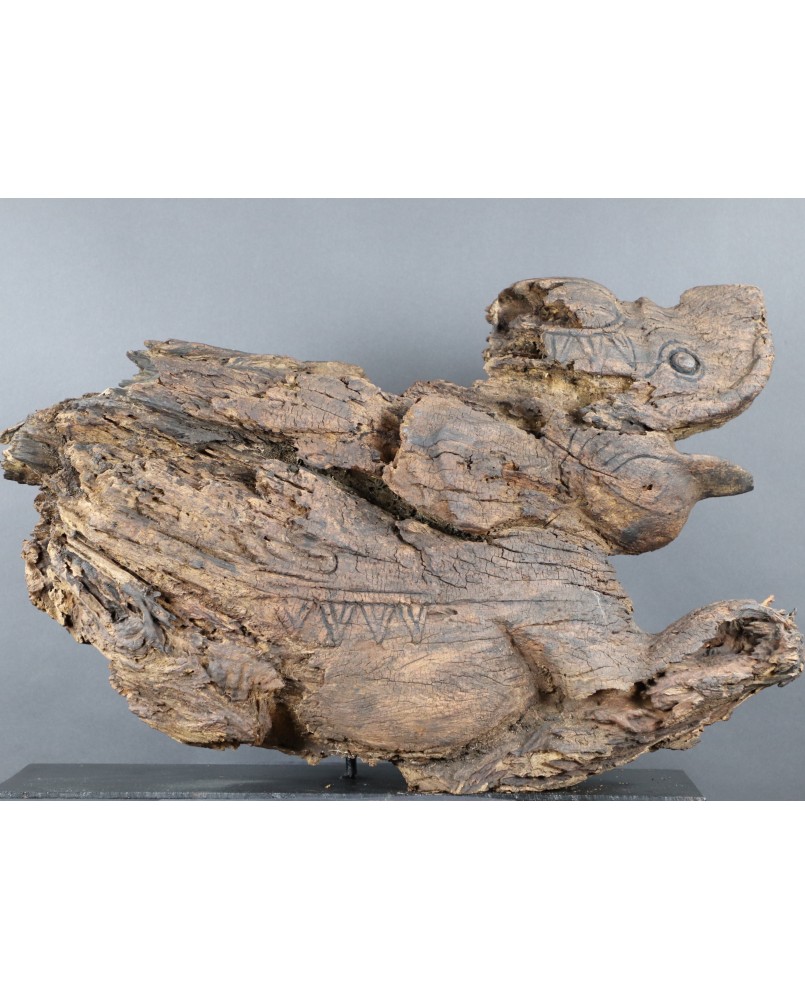

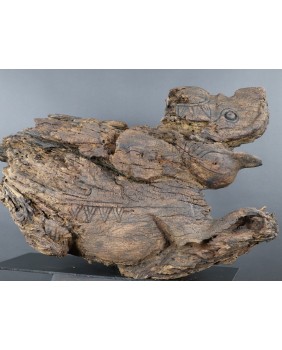
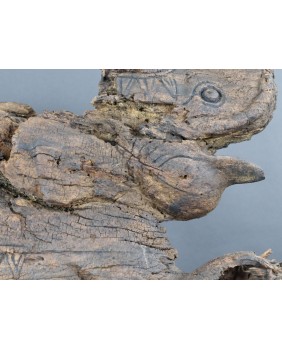
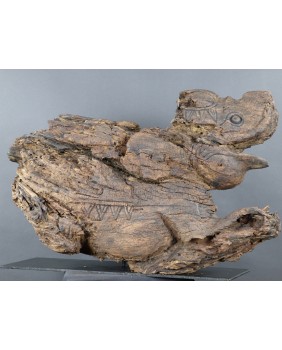
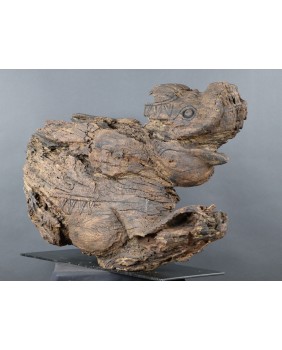
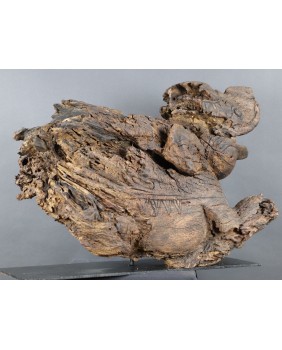
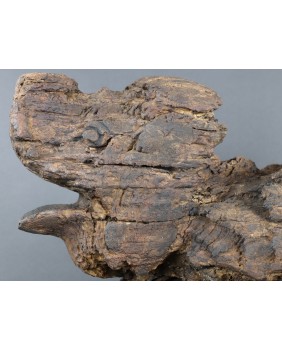
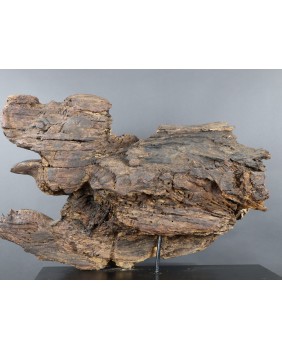
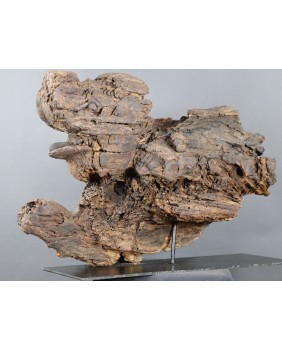
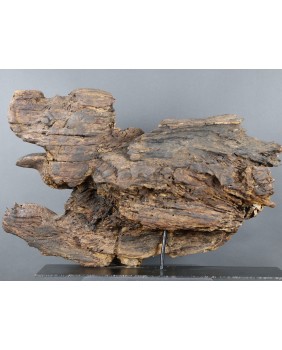
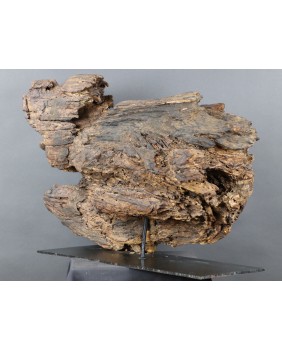
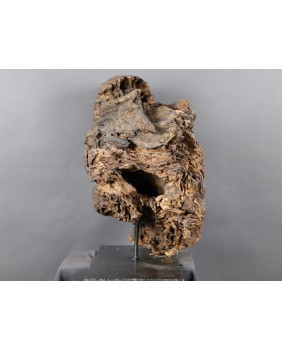
In accordance with the second meaning of the Chinese word, I am selling rather the idea, the image of the magnificence of this sculpture from the time of its creation. What has been preserved suggests that it was dynamic and depicted an elephant in decorative harness, the remains of which can still be seen today. The animal probably had its trunk raised and was in motion, perhaps running. But these are only imaginings.
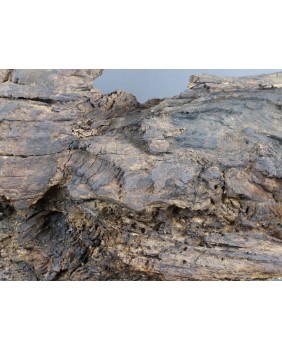
I always say that an old wooden sculpture has two authors. The artist who used a chisel to transform the wood into the intended shape, and time, which treats that shape in different ways. The elephant he sells was unlucky. Probably exposed to direct weather conditions, it has survived only in fragmentary form. It takes a lot of imagination to see a magnificent elephant sculpture in this piece of damaged wood. I bought it in a Parisian antique shop. It was described as Chinese, dating from the 18th century. I have no reason to doubt that this is indeed the case, as all the items I have purchased in this shop so far have turned out to be what the seller said they were.
In China, as well as in the art of the Middle Kingdom, the elephant has symbolic meaning. Elephants living in the wild became extinct in this area sometime during the Bronze Age. However, this does not mean that elephants ceased to be present in China. During the Ming dynasty, the Imperial Elephant Stables operated in the Forbidden City. On the sixth day of the sixth month, elephants were ritually washed in the moat surrounding the imperial residence. This is related to the double meaning of the word "elephant" - "xiang". It also means thoughts and illusions. Bathing an elephant is a Buddhist ritual of washing away unnecessary thoughts about this world and directing them towards spiritual perfection and enlightenment. This is a common motif in Chinese art. In addition, the elephant is a symbol of strength, cunning, and luck. Jade elephant statues stood next to the imperial throne. The figure of Bodhisattva was sometimes depicted on an elephant, and the heroes of Chinese epics traveled on them. Marco Polo described in his account a Mongol ruler traveling in a wooden chamber built on the backs of four elephants.
In accordance with the second meaning of the Chinese word, I am selling rather the idea, the image of the magnificence of this sculpture from the time of its creation. What has been preserved suggests that it was dynamic and depicted an elephant in decorative harness, the remains of which can still be seen today. The animal probably had its trunk raised and was in motion, perhaps running. But these are only imaginings.
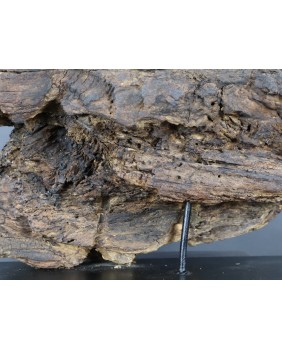
The photos do not fully convey its beauty. It is large, heavy, and dignified. The preserved fragment has been placed on a metal base. Nothing is crumbling off it. Under my watchful eye, it arrived safely from Paris. However, I would not entrust it to a courier company. The sculpture is 48 cm high, 68 cm long, and about 20 cm wide.
By the way, since I am selling the idea, let me say that I can see this sculpture in a raw interior, against a light-colored wall, discreetly illuminated, giving a unique character to the entire interior.
In accordance with the second meaning of the Chinese word, I am selling rather the idea, the image of the magnificence of this sculpture from the time of its creation. What has been preserved suggests that it was dynamic and depicted an elephant in decorative harness, the remains of which can still be seen today. The animal probably had its trunk raised and was in motion, perhaps running. But these are only imaginings.