


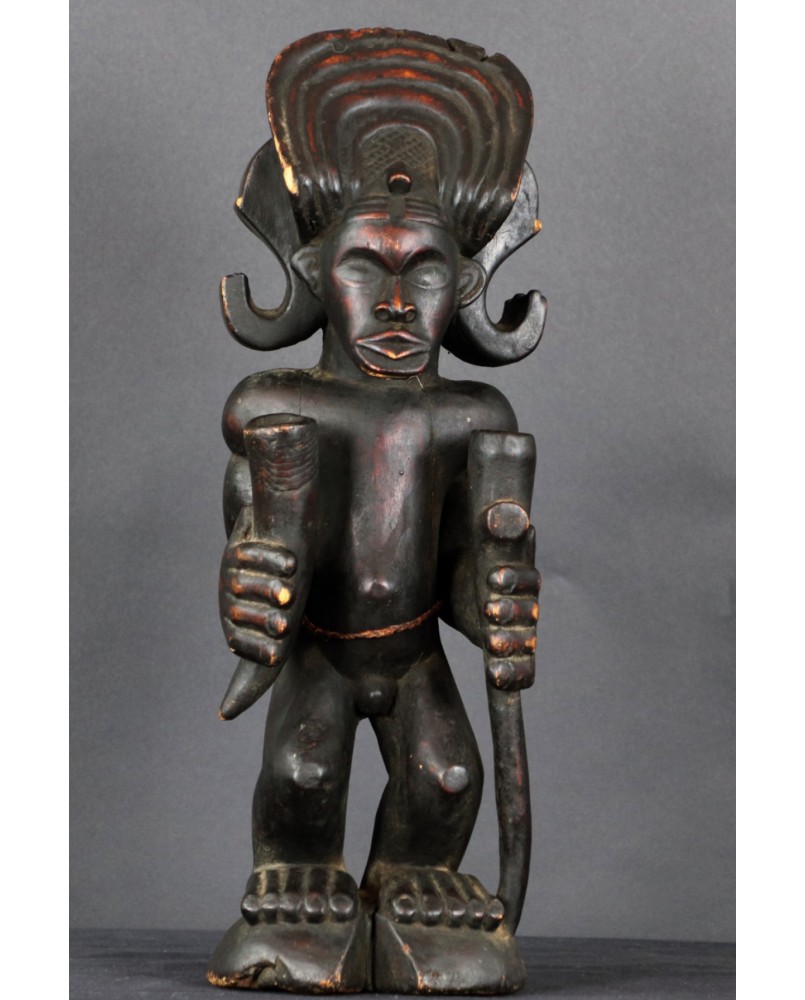
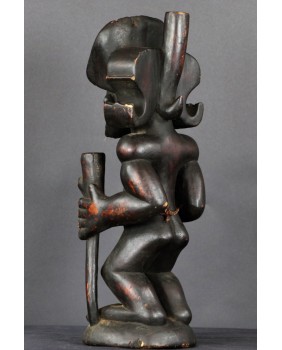
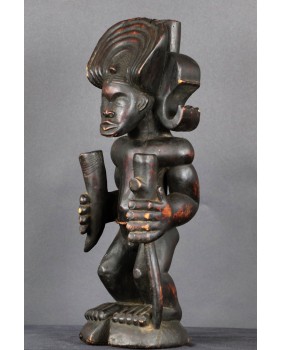
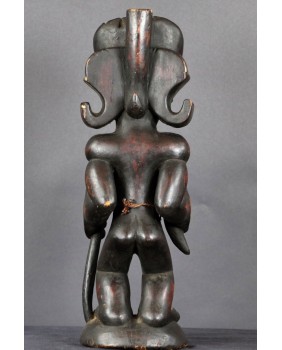
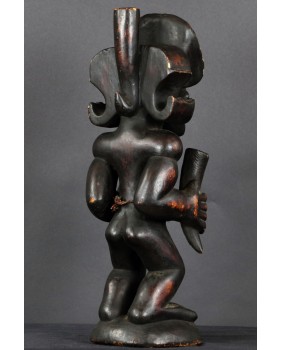
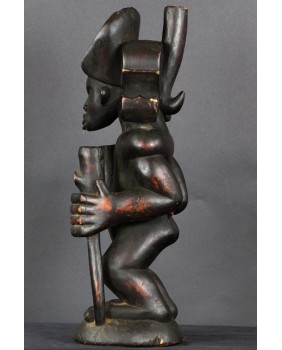
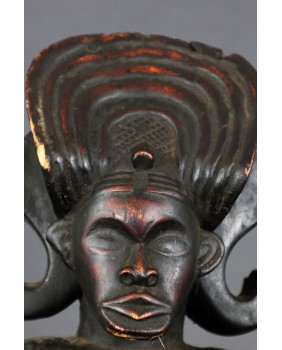
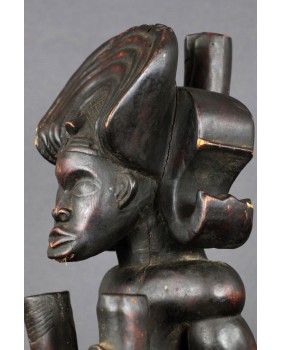
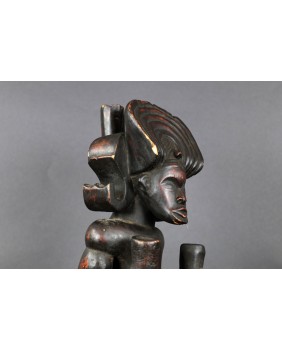
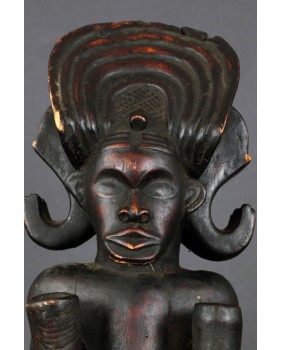
He is a muscular, stocky man standing on bent legs (as if ready to jump). His head is adorned with a powerful hairstyle, a kind of royal crown.
According to the beliefs of the Chokwe community, Chibinda Ilunga was the son of the king of the Lunda tribe. He fell in love with and married Princess Lueja, heir to the throne of the neighboring Luba tribe. This did not please the princess's father and brothers. The young couple had to leave the kingdom. They gave rise to a new ethnic group, the Chokwe. Chibinga established a kingdom in which he served as king with divine magical powers. Legend has it that he taught his subjects how to hunt. The tribe lived in an area with a large elephant population. They knew how to hunt them, and later the Chokwe obtained ivory for Portuguese traders.
The Chokwe created sophisticated art, especially sculpture. Sculptors played an important role at the royal court. They upheld the authority of the royal power with sculptures of the king himself and his wife, as well as sculptures of ancestors, whose belief cemented the kingdom. Chokwe art influenced their neighbors, the Lunda, Luvala, Minunga, Mbwena, and Songa. It also influenced the quite distinctive art of the Luba.
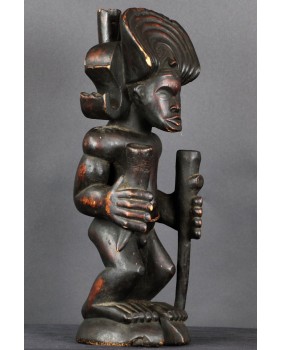
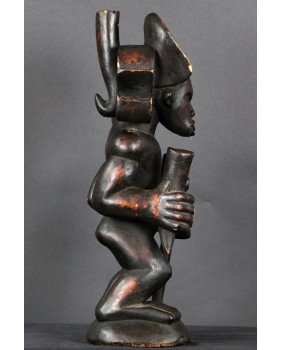
The sculpture I am offering is a typical representation of King Ilunga. He is a muscular, stocky man standing on bent legs (as if ready to jump). His head is adorned with a powerful hairstyle, a kind of royal crown. The figure holds a stick, a symbol of power, and an antelope horn containing a magical substance that gives the king supernatural, divine powers. The sculpture symbolizes the king's strength, bravery, majesty, and intelligence.
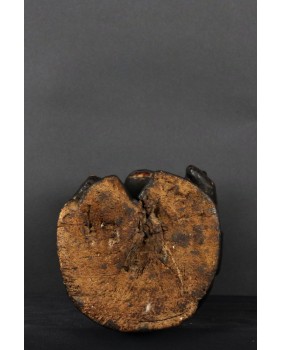
The figure has a nice patina. I found information that it is created by preserving the sculpture with palm oil. There is a slit in the lower part of the face where a beard made of hair was attached. The beard emphasized the king's solemnity. Unfortunately, it has not been preserved. The sculpture is in good condition. The cracks are the result of age, which I would estimate to be from the early second half of the 20th century. It is 45 cm high, 16 cm wide, and 15 cm deep. I recommend it.
He is a muscular, stocky man standing on bent legs (as if ready to jump). His head is adorned with a powerful hairstyle, a kind of royal crown.